How Do You Know if Your Eyes Are Dilating
What Causes Dilated Pupils (Dilated Eyes)?

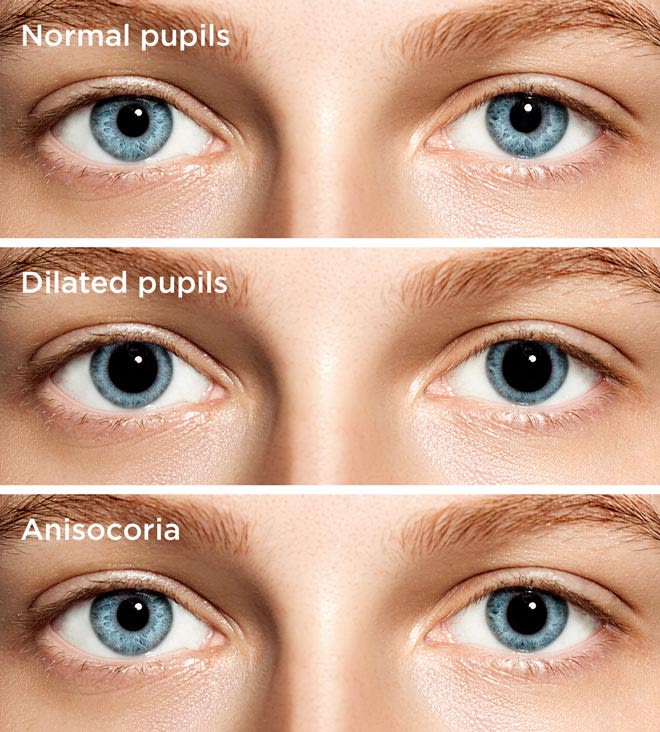
Dilated pupils are pupils that are larger than normal. They are sometimes called dilated eyes.
The size of your pupils is controlled past tiny muscles in the colored part of your center (iris) and the amount of light reaching your eyes.
In bright light, your pupils tuck (get smaller) to prevent too much lite from entering your optics. In dim lighting, your pupils amplify (get larger) to allow more low-cal in.
Normal student size mostly ranges from two.0 to 4.0 millimeters (mm) in bright light, and 4.0 to 8.0 mm in the dark. To some degree, student size tends to get smaller with age.
In ane study of 500 Americans ages 18 to 34 years, average pupil sizes in three different lighting weather were found to be:
-
iii.35 mm in direct light
-
iii.86 mm in normal room lighting
-
6.41 mm in near-full darkness
If your pupils are significantly larger than these averages, you have dilated pupils.
A dilated educatee can sometimes nevertheless react to lite — that is, go smaller in bright light or when a light is shined at the eye. But typically, dilated eyes don't respond normally to light.
A big student that is completely unresponsive to low-cal is called a "fixed" dilated pupil.
Dilated pupils aren't the same equally anisocoria, a common condition where both pupils react ordinarily to calorie-free but differ in size by about a half-millimeter or more than. Anisocoria is benign and affects about 20% of the population.
Come across RELATED: Minor pupils: What exercise they hateful?
What causes dilated pupils?
The most common dilated pupil causes include:
Medications
The following prescription and not-prescription medicines can cause your pupils to amplify and affect their ability to react to calorie-free:
-
Antihistamines
-
Decongestants
-
Tricyclic antidepressants
-
Motion sickness medicines
-
Anti-nausea medicines
-
Anti-seizure drugs
-
Medications for Parkinson'southward disease
-
Botox and other medications containing botulinum toxin
-
Atropine (used for myopia control and other medical purposes)
Centre injury
A serious, penetrating center injury can damage your iris and cause the pupil to become dilated and irregular in shape. Sometimes, this sort of injury tin occur during an heart surgery, such as a complicated cataract surgery or a corneal transplant.
Brain injury or affliction
A head injury, stroke or encephalon tumor tin bear upon how your pupils react to light and cause dilated pupils. One or both optics may exist affected.
This is why you see physicians checking an athlete'due south pupils with a penlight post-obit head trauma sustained during sporting events, or when a patient arrives at a hospital emergency department with other possible stroke symptoms.
Recreational drug apply
Research has shown that alcohol and marijuana — separately or in combination — tin reduce your optics' ability to recover from exposure to a bright light source (such every bit oncoming headlights at night) and adapt to changing light atmospheric condition. This event can concluding two hours or longer after drug ingestion.
However, the substances themselves practice not cause your pupils to dilate.
A number of illegal drugs, however, practise directly cause dilated pupils. This slows your eyes' power to react to light.
These drugs include:
-
Amphetamines
-
Cocaine
-
LSD
-
MDMA (Ecstasy)
SEE RELATED: Eye dilation FAQs
Beneficial episodic unilateral mydriasis
This is an unusual but harmless status where a person experiences sporadic episodes of one pupil suddenly becoming dilated, frequently accompanied by blurry vision, headache and center pain.
Young women who are prone to migraine appear to accept the highest take a chance of benign episodic unilateral mydriasis. In one study, the median elapsing of the episodes was 12 hours (some lasted much longer) and the median frequency was 2 to three episodes per month.
The condition resolves and the student returns to normal size and function without treatment.
Adie's pupil
Also chosen Adie's tonic pupil or tonic pupil, this is a rare neurological disorder where one pupil is larger than normal and is slow to react to low-cal. Sometimes, the student does non constrict at all.
This educatee aberration may be accompanied past poor or absent tendon reflexes. When this occurs, the status is called Adie'due south syndrome.
More often than not, the cause of Adie's tonic pupil is unknown; but in some cases, it may exist associated with trauma, surgery, poor blood circulation or infection. There's no cure for Adie's educatee or Adie'due south syndrome.
Congenital aniridia
This is a rare status where a person is born with a partially or completely absent iris, resulting in a very large "pupil." Aniridia usually affects both eyes and is accompanied by other serious eye issues such equally congenital cataracts, glaucoma, incomplete development of the retina and optic nerve, nystagmus, and decreased visual vigil.
Because there is little or no iris to regulate the amount of light entering the centre, people with aniridia are very sensitive to light.
Sexual attraction
It's true — researchers have found that pupil dilation appears to represent to adult men and women's sexual interest in other adults. But there's a catch.
1 recent study showed that the pupils of male person subjects dilated when they viewed images of women they found sexually attractive, whereas the pupils of female person subjects typically dilated in response to images of attractive men and women akin. The study authors concluded the reason for this is unclear and that further research is warranted.
Treatment for dilated pupils
If you or someone else notices you accept dilated pupils or one of your pupils looks larger than the other later on caput trauma, seek medical attention immediately.
The same is true if you experience sudden dizziness, headache, confusion, residual problems or other symptoms of a possible stroke.
If you detect dilated pupils after you've started taking ane of the medications noted above, call your prescribing doctor for advice.
In cases other than those described above, telephone call your eye doctor immediately for advice if you notice your pupils are dilated — especially if it comes on suddenly.
If you lot have dilated pupils or your pupils react slower than normal to changing light atmospheric condition, you volition be more sensitive to sunlight. Eyeglasses that darken automatically in daylight or sunglasses with polarized lenses can make your eyes feel more comfortable outdoors.
Custom prosthetic contact lenses can also assistance reduce light sensitivity acquired past dilated eyes. These lenses give the appearance of having equal pupils of normal size. Prosthetic contacts are peculiarly benign for cases of aniridia and large, irregular pupils caused by trauma.
READ NEXT: What is a blown pupil?
Page published in Feb 2019
Folio updated in January 2022
Source: https://www.allaboutvision.com/conditions/dilated-pupils.htm
0 Response to "How Do You Know if Your Eyes Are Dilating"
Post a Comment